
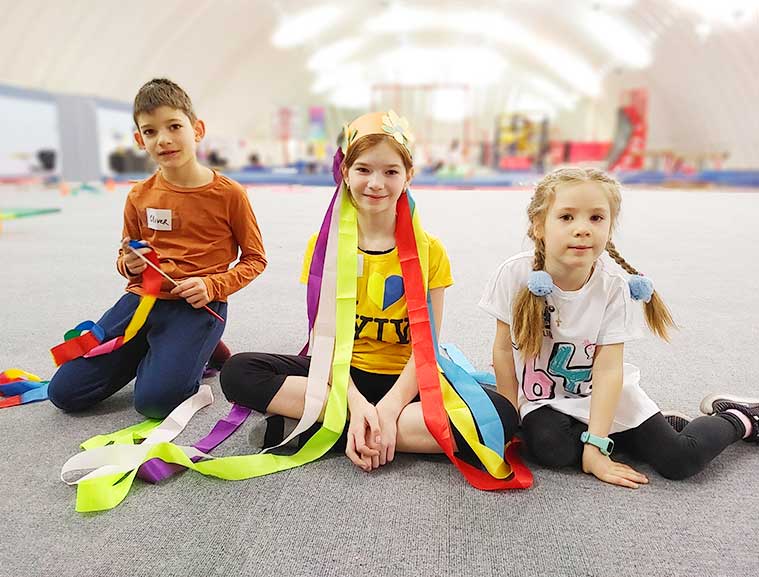
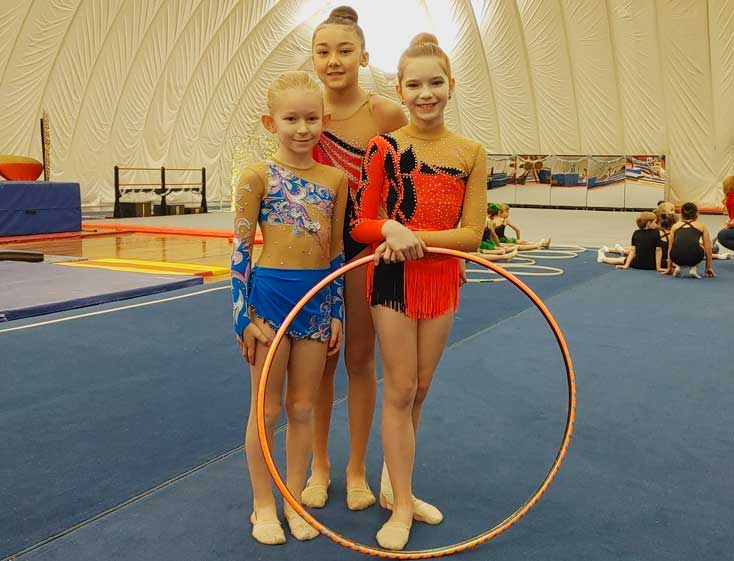
Rhythmic gymnastics (short: RG) one of the most elegant sport disciplines. It has a similar origins to Women's Artistic gymnastics (WAG). Rhythmic gymnasts perform on a floor with an apparatus, accompanied by music, in individual or group events.
Rhythmic gymnastics is a sport that combines elements of gymnastics, dance, and hand apparatus manipulation. Gymnasts compete and earn the points, determined by a panel of judges, for leaps, balances, pirouettes, flexibility, apparatus handling, execution, and artistic effect.
Rhythmic gymnastics has 5 hand apparatus – rope, hoop, ball, clubs, ribbon.
International competitions are split between juniors, under sixteen by their year of birth; and seniors, for women sixteen and over again by their year of birth.
The largest events in the sport are the Olympic Games, World Championships, and World Cups.
Early years of Rhythmic gymnastics was emerged in Russia in 1914 by ballet artists of Mariinsky Theatre. They developed a course of aesthetic gymnastics.
They were influenced by great masters such as Francois Delsarte, Emile Jaques-Dalcroze, George Demenii and Isadora Duncan.
In 1941 there was first competition of Rhythmic gymnastics that took place in Saint Petersburg.
In 1948 there was first Soviet Union championship of Rhythmic gymnastics.
Officially RG was recognized by FIG in 1963, when the first Word Championship took place in Hungary.
That year soviet gymnast Liudmila Savinkova was first Word Championship winner in this sport.
The first time rhythmic gymnastics was in the Olympics was in 1984 in Los Angeles.
That year, Canadian gymnast called Lori Fung won the individual competition.
In 1996, rhythmic gymnastics group competitions were added in to the Olympics.
Lori Fung

Marina Lobach

Alexandra Timoshenko

Ekaterina Serebrianskaya
Yulia Barsukova

Alina Kabaeva
Evgenia Kanaeva
Evgenia Kanaeva
Margarita Mamun
Linoy Ashram
